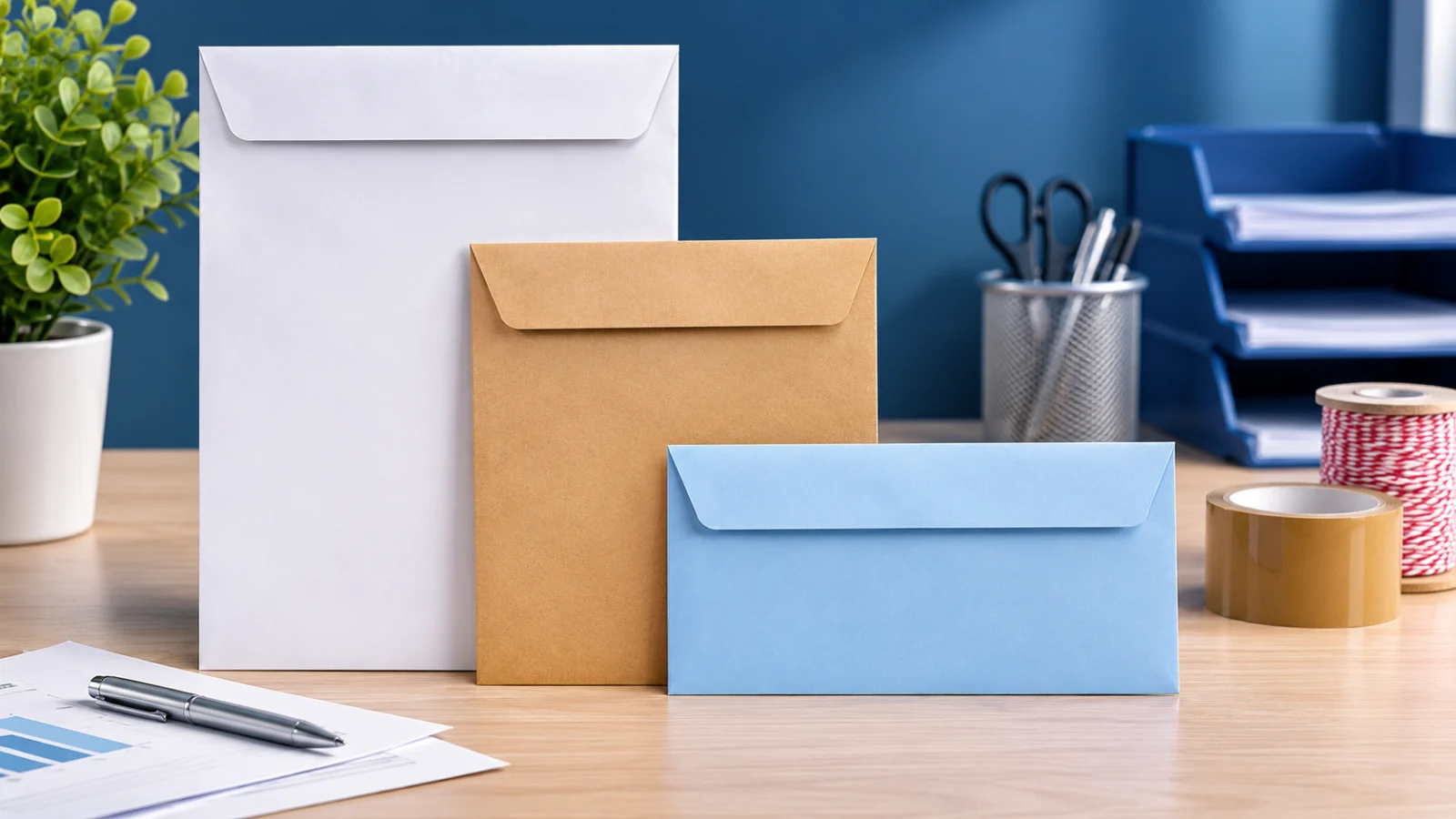
The easiest way to choose an envelope is to start with the document and decide whether it can be folded. A4 invoices, contracts, marketing leaflets and certificates can require different formats even when they all begin as the same paper size. Selecting the wrong envelope can increase packing time, allow unwanted creasing or place a mailing in a different postage category.
This practical guide compares the three envelope sizes most commonly used for UK business correspondence — DL, C5 and C4 — and explains when padded or board-backed mailers may be more appropriate.
UK envelope sizes at a glance
| Envelope | Standard dimensions | Usually fits | Typical application |
|---|---|---|---|
| DL | 110 × 220mm | A4 folded into thirds | Invoices, letters and payment notices |
| C5 | 162 × 229mm | A5 flat or A4 folded once | Letters, invitations and small booklets |
| C4 | 229 × 324mm | A4 flat (unfolded) | Contracts, certificates and full-size documents |
| C6 | 114 × 162mm | A6 flat or A4 folded twice | Small cards and correspondence |
Envelope dimensions refer to the outer format. Available internal space can be affected by seams, padding, gussets or other features. Size charts published by specialist UK envelope manufacturers, including Blake, confirm the DL, C5 and C4 measurements above.
1. DL envelopes: a practical choice for everyday letters
A DL envelope is 110 × 220mm. It is designed to hold A4 paper folded into thirds. This makes it particularly useful when a business sends large numbers of standard letters, statements or invoices that do not need to remain flat.
For recurring mailings, check the envelope’s window position if the recipient address is printed on the letter itself. The positioning of text on the inserted document should align with the chosen window format after the paper is folded.
Best first check: fold a real document, insert it and confirm that the text, address and any QR or payment references remain visible and readable where intended.
2. C5 envelopes: for A4 folded once
A C5 envelope measures 162 × 229mm. It holds a standard A5 sheet flat or A4 paper folded in half. This can be a good middle ground where documents do not suit a three-fold arrangement, such as some invitations, short reports or promotional literature.
For postage, a standard unpadded C5 envelope may fall within Royal Mail’s ordinary Letter dimensions, provided the complete item stays within the thickness and weight limits. The paper, inserts and envelope all contribute to those measurements.
3. C4 envelopes: send an A4 document without folding
A C4 envelope measures 229 × 324mm, allowing standard A4 sheets (210 × 297mm) to be inserted flat. These are frequently chosen for important contracts, certificates, presentation sheets and documents that should not be creased.
A C4 envelope is too large for the standard Royal Mail Letter format. It may qualify as a Large Letter if the sealed item’s dimensions, thickness and weight are within the relevant limits. That distinction matters when comparing mailroom costs.
4. Letter or Large Letter? Royal Mail size limits
Royal Mail publishes maximum measurements for standard UK mail formats. These apply to the finished, sealed item, including contents and any protective packaging:
| Format | Maximum length | Maximum width | Maximum thickness | Maximum weight |
|---|---|---|---|---|
| Letter | 240mm | 165mm | 5mm | 100g |
| Large Letter | 353mm | 250mm | 25mm | 750g |
These are the general 1st and 2nd Class limits; some business-specific or machine-readable services have additional requirements. Check the exact service before a large mailing. A DL or C5 envelope can become too thick or heavy for a Letter. Conversely, a flat C4 may remain within Large Letter dimensions but is not guaranteed to qualify without measuring and weighing the finished pack.
5. When should you use padded or board-backed envelopes?
Padded envelopes
Bubble-lined or other padded envelopes may provide useful cushioning for suitable small items. Their outer size alone does not determine the postage format: the filled thickness matters. They should not be assumed to replace a protective carton for delicate or expensive products.
Board-backed, “Do Not Bend” envelopes
Board-backed envelopes include a stiff backing that can help reduce bending during handling. They are often useful for prints, certificates and paperwork that needs to stay flatter than it would in an ordinary paper envelope. They cannot guarantee a document will never be bent or damaged, so choose a construction appropriate to the item.
Gusset envelopes
A gusset adds extra depth for thicker document packs or booklets. That additional filled depth must still be checked against the relevant carrier’s postage limits.
6. Compare sealing methods before ordering a case
- Gummed envelopes: require moisture to activate the adhesive. Check whether they suit the volume and equipment used.
- Peel-and-seal: have a protective release strip removed before sealing, often convenient for manual packing and small batches.
- Self-seal: typically use adhesive surfaces that bond when brought together; handling and shelf-life guidance depend on the product.
For a mailroom preparing large batches, the ideal choice may depend on insertion machinery, seal consistency, operator time and storage conditions rather than a simple comparison of per-envelope cost.
7. A three-minute envelope buying checklist
- Measure the actual insert or document stack.
- Decide whether folding is acceptable.
- Choose DL, C5, C4 or a protective format with suitable internal space.
- Check whether you need an address window, opaque paper or a particular security pattern.
- Compare peel-and-seal, gummed or self-seal closures for your packing process.
- Weigh and measure a sealed sample using the intended paper and inserts.
- Confirm the ordered quantity: envelopes per box, minimum order and storage space.
For a recurring mail run, keep one approved sample with the purchasing specification. This helps prevent a later substitution to a superficially similar envelope that behaves differently.
8. Common buying scenarios
| What you are sending | Practical starting point | Final check |
|---|---|---|
| Routine A4 invoice that can be folded | DL | Three-fold position and window alignment |
| Short A4 letter folded once | C5 | Finished thickness and overall weight |
| Unfolded A4 certificate | C4 or board-backed C4 | Protection, thickness and Large Letter eligibility |
| Small, non-fragile sample with padding | Appropriate padded mailer | Filled dimensions, weight and handling protection |
The right format depends on the contents. If you send products rather than paperwork, our mailing bags buying guide explains flexible mailers, film thickness and packing fit.
Frequently asked questions
Will an A4 sheet fit into a C4 envelope without folding?
Yes. Standard A4 paper is 210 × 297mm and a standard C4 envelope is 229 × 324mm.
Does C5 count as Letter postage?
A standard C5 envelope is within Royal Mail’s Letter length and width limits, but the full item must also meet the maximum thickness, weight and relevant service requirements.
Is C4 the same size as A4?
No. C4 is intentionally larger so that an A4 sheet fits inside without folding.
Is a “Do Not Bend” envelope fully rigid?
Not necessarily. The construction may resist bending, but stiffness and protection differ by product. For high-value or fragile contents, test the packaging and consider additional protection.
Should a business buy envelopes by the box or pallet?
That depends on monthly demand, available storage space, specification consistency and delivered cost. Confirm the pack quantity before comparing prices.
Wholesale envelopes and despatch supplies
Genuine Centre Ltd welcomes trade enquiries for packaging materials, including envelopes, protective mailers, bags and tape. Let our team know whether you need DL, C5, C4 or another size, the preferred closure and your usual order quantity. Contact Genuine Centre Ltd for current availability and supply enquiries.
More GCL buying guides
Sources and further reading
- Blake Envelopes & Packaging: Envelope formats and measurements
- Royal Mail: Letter and Large Letter formats
- Royal Mail Business Mail: Size and machine-readability distinctions
- Post Office: How to send a letter
Research checked: 11 November 2026. Postal prices, service-specific requirements and packaging specifications can change. Verify them before a mailing campaign.