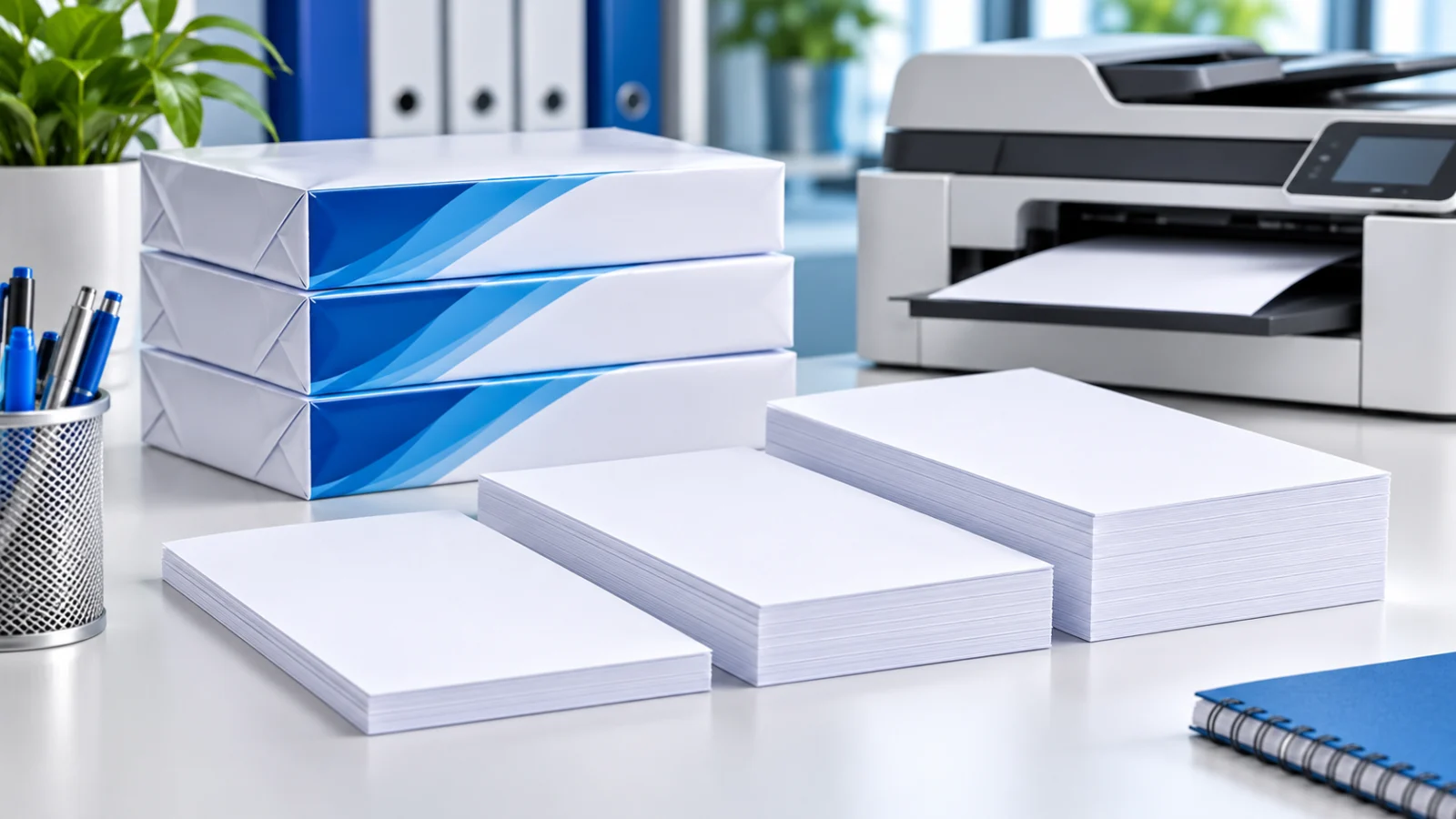
For most UK offices, 80gsm A4 paper is a sensible baseline for day-to-day documents, but it is not the only worthwhile option. Higher-volume internal printing may justify assessing 75gsm stock, while 90gsm can be worth testing for presentations and important correspondence. The right choice also depends on the individual paper’s opacity, stiffness, surface finish, printer compatibility and price.
This guide explains what GSM means, compares 75, 80 and 90gsm A4 sheets, and gives procurement buyers a practical checklist for ordering paper by the ream, carton or pallet.
What does GSM mean on copier paper?
GSM stands for grams per square metre (g/m²). It tells you the mass of one square metre of paper, not the number of sheets in a packet or a direct measurement of thickness.
All standard A4 sheets measure 210 × 297mm. An 80gsm sheet has a basis weight of 80 grams per square metre. A single A4 sheet covers 0.06237m², so its approximate theoretical mass is 4.99g (80 × 0.06237). Differences in manufacturing can still affect thickness, stiffness and feeding performance.
75gsm vs 80gsm vs 90gsm: quick comparison
| Paper weight | Common buying consideration | Typical business use |
|---|---|---|
| 75gsm | Lower paper mass per sheet; consider print visibility and machine feeding on the chosen brand. | High-volume internal documents, short-term records and general office printing. |
| 80gsm | Widely used standard office weight; a practical starting point for mixed printers. | Routine letters, reports, invoices and copying. |
| 90gsm | More paper mass per sheet; selected grades can offer higher opacity and a firmer feel. | Client correspondence, reports, some colour charts and higher-presentation documents. |
The table describes common uses, not a guarantee of print performance. An excellent 75gsm paper may outperform a poor 80gsm product in a particular machine. Compare technical specifications of actual brands rather than GSM alone.
What changes when you choose heavier paper?
Weight and handling
Higher GSM means more paper mass for the same size and number of sheets. That may be noticeable in high-volume shipping, filing or archiving, although the total cost difference depends on the product and logistics.
Opacity
Opacity affects how much printing shows through from the reverse side. It can matter for duplex (two-sided) printing and double-sided promotional leaflets. It is influenced by fibre, fillers and manufacturing, not only basis weight.
Thickness and stiffness
Thickness (sometimes called caliper) is usually stated in microns. Two papers with the same GSM can have different calipers and stiffness. Printer feed paths and duplex units can respond differently to those characteristics.
Whiteness, brightness and surface
High whiteness may produce a different visual impression, but it does not automatically mean a paper is better for every printer. If customer-facing colour reproduction matters, check manufacturer specifications or test a sample with your actual artwork.
What do manufacturer data sheets show?
Technical data from Pioneer Office illustrates why it is useful to compare beyond weight. Its published specifications give the following values for certain grades in the same product family:
| Pioneer Office grade | Opacity | Nominal thickness |
|---|---|---|
| 75gsm | 93% | 103µm |
| 80gsm | 95% | 108µm |
| 90gsm | 96% | 112µm |
These are figures for Pioneer Office grades, not industry-wide values. Another manufacturer may produce different results. Premier Paper likewise publishes several basis weights with distinct opacity, stiffness and thickness figures in its Elements Business range. The procurement lesson: ask for an individual paper’s data sheet rather than assuming every 90gsm sheet behaves identically.
How heavy is one A4 ream?
For a 500-sheet ream of A4, the approximate mass of the paper itself is:
| Basis weight | 500 sheets of A4, approximate |
|---|---|
| 75gsm | 2.34kg |
| 80gsm | 2.49kg |
| 90gsm | 2.81kg |
These figures are calculated from nominal GSM and A4 area; they exclude wrappers, boxes and pallets. Actual weight varies with manufacturing tolerances and moisture content.
A carton holding five 500-sheet reams contains 2,500 sheets. However, packs and carton configurations differ, so always compare the advertised number of sheets, not simply “one box”.
Buying A4 paper in bulk: what to check
- Machine compatibility: check the printer or copier manufacturer’s supported media weights and types.
- Print use: how much of the workload is black text, full-colour, duplex or customer-facing?
- Opacity and feed quality: test small batches of your most demanding double-sided jobs.
- Paper finish and whiteness: ask for comparable technical data, not just “premium” branding.
- Packaging configuration: sheets per ream, reams per case and cases per pallet.
- Storage conditions: keep paper protected from damp and major temperature swings; follow the product’s handling guidance.
- Documented environmental claims: if a tender requires FSC, PEFC or recycled-content evidence, check the specific product documentation rather than assuming certification.
Is 75gsm always cheaper than 80gsm?
Not necessarily. Price is affected by brand, fibre specification, whiteness, packaging, order volume and delivery terms. A cost-per-sheet calculation makes suppliers easier to compare:
Cost per 1,000 sheets = delivered price ÷ total sheets × 1,000.
For example, a hypothetical carton of 2,500 sheets delivered for £15 costs £6 per 1,000 sheets (£15 ÷ 2,500 × 1,000). This is a calculation example only, not a current GCL selling price.
Also consider whether an alternative paper causes extra misfeeds, jams or reprints in the equipment you use. One well-chosen paper stock may be better for an office than constantly changing grades to chase the lowest carton price.
Should an office use one grade for everything?
Not always. A sensible procurement policy might use a consistent everyday grade for routine printing and retain a smaller quantity of a higher-grammage stock for specific communications. This can simplify purchasing while allowing flexibility for customer-facing documents.
If you use both laser and inkjet machines, seek a multifunction paper described as compatible with both or consult the paper manufacturer’s documentation. Special coatings designed for particular print processes should not be treated as interchangeable with ordinary uncoated copy paper.
Frequently asked questions
Does 80gsm mean an A4 sheet weighs 80 grams?
No. GSM is grams per square metre. An A4 sheet occupies only 0.06237m², so a nominal 80gsm sheet weighs approximately 5g.
Is 90gsm better for double-sided printing?
Some 90gsm grades offer improved opacity, but check the chosen product’s specifications and test duplex printing in your equipment.
What should I order for a large office?
First quantify average monthly sheet use and printing requirements. Then compare delivered price per 1,000 sheets, the paper’s technical specifications and storage capacity.
Does thicker paper always stop printer jams?
No. Feeding depends on factors such as paper characteristics, conditioning, machine maintenance and approved media range. A higher GSM is not a remedy for an unsuitable or faulty printer.
Enquire about bulk A4 paper and office supplies
Genuine Centre Ltd welcomes wholesale enquiries about office consumables and paper products. Tell us your preferred grade, brand, monthly volume, delivery location and whether you buy by the carton or pallet. You can contact the trade team or explore our brand directory.
More GCL buying guides
Sources and further reading
- Pioneer Office: Product family and technical comparison
- Premier Paper: Elements Business technical grades
- Premier Paper: Example 75gsm HP Everyday A4 listing
- Premier Paper: Example 80gsm A4 listing
Research checked: 11 November 2026. Example calculations and typical-use guidance are not a substitute for individual product technical data sheets or machine compatibility requirements.