Bubble-lined mailers and paper-padded mailers both cushion small products in transit, but the better choice depends on the damage you need to prevent, the thickness of the finished pack and the recycling instructions for the specific construction. A board-backed envelope may be better where bending is the principal concern, while fragile or crush-sensitive goods can need a rigid box and internal cushioning.
For UK fulfilment teams and wholesale buyers, the objective is to choose a repeatable packaging specification that keeps orders protected without unnecessarily increasing postage or packing time. This guide explains how to compare protective mailers and run a practical trial before committing to bulk quantities.
Bubble-lined vs paper-padded mailers: what is the difference?
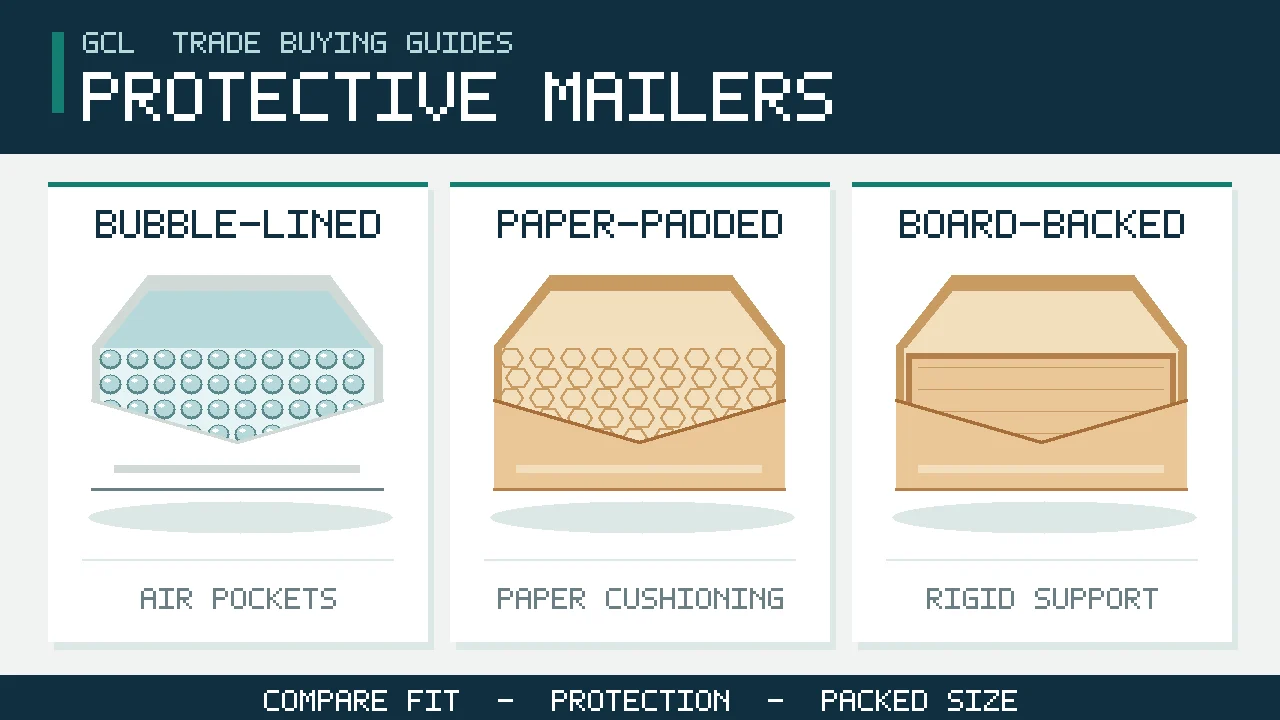
A conventional bubble-lined envelope typically combines a paper or film outer with a plastic air-cell lining. The cells provide a cushioning layer around the contents. A paper-padded envelope instead uses a paper-based cushioning structure, such as macerated fibre, expanded honeycomb or shaped paper. These constructions are not identical: their thickness, stiffness, resistance to moisture and ability to recover after compression can vary.
A board-backed envelope has a comparatively stiff backing to help resist bending; it is not necessarily padded. Some rigid postal mailers use board on both sides. Identify the actual material and construction rather than assuming that the words “padded”, “eco” or “do not bend” describe a particular technical performance.
| Format | Consider for | Main checks before ordering |
|---|---|---|
| Bubble-lined envelope | Small, robust accessories and items that need light cushioning | Usable opening, lining integrity, seam strength and separation of materials for recycling |
| Paper-padded envelope | Goods needing cushioning where a paper-based construction is preferred | Padding depth, filled thickness, closure, and documented recycling instructions |
| Board-backed envelope | Prints, certificates and other flat goods susceptible to creasing | Board stiffness, corner protection and resistance to moisture |
| Rigid carton with inserts | Crush-sensitive, fragile, heavy or irregular products | Box strength, internal restraint, cushioning and total shipment size |
These are starting points for trials, not universal product ratings or verified claims about GCL stock. For more on carton construction, see the single-wall and double-wall cardboard box guide.
Match the mailer to the likely damage
Start by examining how your product could fail. A small cable in its own retail sleeve might need protection from scuffing and minor knocks. A printed certificate needs stiffness to prevent folding. A boxed component with sharp corners may puncture a thin lining or tear a seam. A glass bottle or a delicate electronic display can be damaged by concentrated pressure even if wrapped in a flexible padded envelope.
Do not confuse cushioning with crush resistance. Flexible padding can absorb some impact, but it does not provide a rigid load-bearing structure. For products that must not be compressed, move to an appropriate carton with suitable inserts and verify that the product cannot shift inside it. Likewise, a “do not bend” instruction does not make a flexible envelope rigid.
For ordinary correspondence rather than merchandise, use the GCL guide to C4, C5 and DL envelope sizes.
Measure the usable space, not just the size code
Supplier size codes are useful for reordering an identical product, but they are not a substitute for measurements when changing construction or brand. Ask for the internal width, usable internal length to the closure, external dimensions and manufacturing tolerances. Check whether the flap is excluded from the stated length and whether the internal opening is narrower than the nominal body.
For a rectangular item, a rough first estimate for a flat, non-gusseted mailer is to allow the item’s thickness in addition to its width and length, then add enough clearance for insertion and closing. Padding and seams can reduce usable room further. This is only a screening estimate: pack real samples before buying in bulk.
For example, a boxed accessory measuring 145 × 100 × 15 mm may need at least around 160 × 115 mm of usable flat space before handling clearance is added. A mailer quoted at those exact dimensions may still be too tight. A slightly larger sample should close with the adhesive strip fully engaged, without folding the item or pulling the seams apart.
Keep Royal Mail Large Letter limits in mind
For Royal Mail’s published domestic 1st Class formats, the following maximum sizes and weights apply. All dimensions refer to the finished item including the envelope, padding, contents and label.
| Format | Maximum dimensions | Maximum weight |
|---|---|---|
| Letter | 240 × 165 × 5 mm | 100 g |
| Large Letter | 353 × 250 × 25 mm | 750 g |
| Small Parcel | 450 × 350 × 160 mm | 2 kg |
Check the chosen carrier and account service separately; business contract products may have different terms. Measure the thickest part of the sealed mailer in its normal packed condition, including seams and local bulges. Do not deliberately compress the cushioning to force the item through a size gauge. A 23 mm product has only 2 mm of remaining depth before the 25 mm Large Letter ceiling, and may not fit once padded.
If keeping an order within Large Letter requires compromising protection, use a larger service instead. The cost of a damaged replacement can outweigh the postage saving.
Run a controlled sample trial before switching
A trade buyer comparing two mailers can establish a simple acceptance sheet. Use the same representative item and packing instructions for each construction, and include the largest or most awkward products in the intended order profile. Repeat across several samples rather than relying on a single neatly packed item.
- Check the time needed to insert the product and close the flap.
- Inspect the seal, seams and corners after packing. Reject packs with stretched joins, exposed adhesive or sharp protrusions.
- Record maximum outside dimensions and weight of every filled sample.
- Check whether the shipping label lies flat and remains attached and readable after normal handling.
- Send representative packs through the intended distribution route, where appropriate, and record product condition and packaging failures.
- Agree an acceptable specification and record the exact size, construction and closure for repeat purchasing.
An operational trial is not a certified laboratory performance test. For high-value, dangerous, regulated or particularly fragile goods, seek appropriate packaging expertise and check the carrier’s restrictions and required protection before dispatch.
Compare cost per packed order, including postage
Suppose a business dispatches 1,000 suitable small orders a month. If a different padded envelope adds 3p to packaging cost, that is £30 more per month before postage, labour or damage costs. If it also moves 40 orders into a higher carrier band, the extra cost is 40 times the actual price difference under that account. Conversely, a more expensive mailer can pay for itself if it demonstrably reduces damage or speeds up packing enough.
These are illustrative figures, not market prices or measured savings. Compare the full packaging system and use actual carrier rates and observed results. Standardising a small number of useful mailer sizes may simplify picking and reduce storage space, but avoid a one-size-fits-all approach if the product range varies substantially.
Are padded mailers recyclable in the UK?
The answer depends on the finished construction and the collection system. A paper exterior does not make an envelope paper-only. Where plastic bubble cushioning is bonded to paper, the whole envelope may be unsuitable for paper recycling. For example, the North London Waste Authority advises residents not to put bubble-lined envelopes in its recycling collection.
Some designs allow the paper and plastic layers to be separated; ask for instructions and check whether both separated materials are accepted by the relevant collection scheme. Paper-padded formats can simplify material separation, but verify the padding, coatings, adhesives and disposal guidance for the exact product. For commercial waste, confirm acceptance with your business waste contractor. Avoid making blanket claims about recyclability across all UK locations.
Frequently asked questions
Is a paper-padded envelope always thicker than a bubble mailer?
No. Padding structure, material specification and compression under normal packing vary. Compare the sealed thickness with the actual contents, not just the empty envelope.
Can I send fragile products in a bubble-lined envelope?
Only if the particular product, cushioning and route are suitable. Fragile items vulnerable to crushing, concentrated impacts or bending commonly require more rigid protection.
Can I order a padded envelope by its A4 or A5 description?
Use that description as a starting point only. Confirm internal and external measurements, because seams and padding may reduce the usable opening and a thick item may need extra clearance.
What details should I include in a wholesale enquiry?
Supply the packed product dimensions, maximum weight, damage risks, monthly quantities by size, preferred materials, closure requirements and carrier format. Ask about samples and tolerances before agreeing a repeat order.
Choose protective mailing supplies for your business
Explore GCL’s packaging supplies information or browse the padded envelope range at ePackagingDirect, our group’s specialist packaging sales website, to compare available product descriptions and purchasing options. Confirm the actual size, construction and availability for your intended application. For trade sourcing or specification enquiries, contact the GCL trade team.
References
- Royal Mail: 1st Class sizes and weight limits (domestic mail formats).
- Tap Telion: Jiffy padded bag technical description (example of macerated paper cushioning).
- Taylor Packaging: Sealed Air Mail Lite mailers (example of bubble-lined construction and separable layers).
- North London Waste Authority: bubble wrap envelopes (example of local recycling restrictions).